
Conatus
Nonfiction by Mayra Hileman
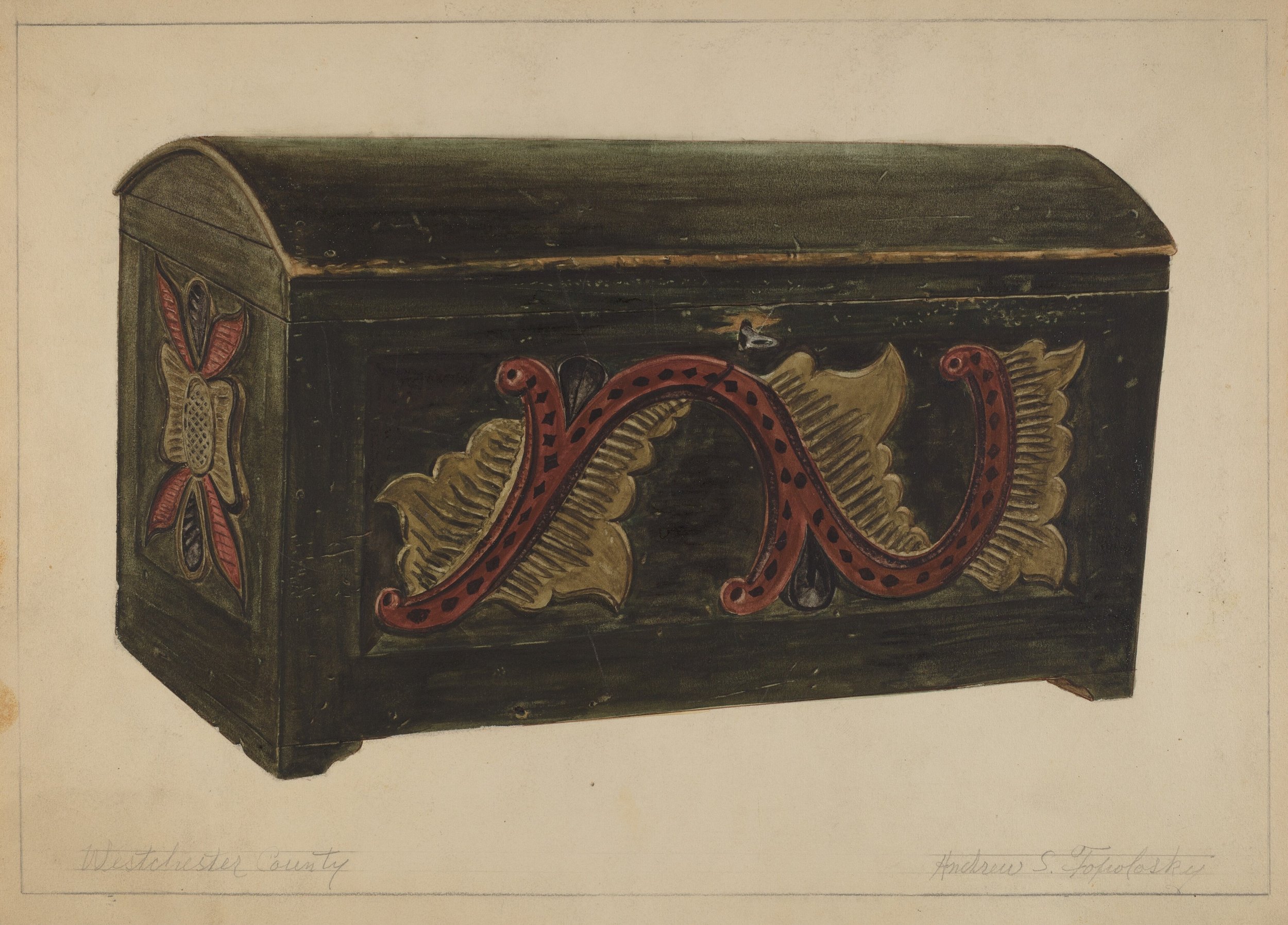
Treasure Chest by Andrew Topolosky, Courtesy National Gallery of Art, Washington
As a child, I was a bit of a hoarder. I loved the idea of collections, of being able to peruse a finished set of something. I couldn’t tell you what a “finished set” really meant to me, but there was a definite sense of completion that I was chasing. This obsession manifested mainly in rocks and coins. My sister and I each owned what we called a treasure box, where whatever we deemed priceless inhabited. Hers was pristine, with birthday cards organized chronologically, and purged regularly. Mine, however, bore the signs of my five-year-old artistic sensibilities—scrawled all over with coloured pencils—and was full to the brim with innumerable little scraps and mementoes that caught my eye. I remember being captivated by the first dime that depicted a different design than the standard sailing ship. It was a tangibly unique object, one that other people also recognized as possessing physical value. Of course, they saw that value as ten cents, and I saw it much more than that.
My family moved around a lot, and I was drawn to objects that so clearly delineated time, objects that showed change and age in their very appearance. I carried my treasure box from house to house, the increasing weight of it grounding me. Coins and rocks are really not the lightest objects to collect. I think the main appeal was the permanence of them, the guarantee that they preceded me, and would likely outlast me.
Also, they were shiny. I didn’t get existential till at least eleven.
I don’t own my treasure box anymore. Somewhere along the way, I let go of what was once so cherished to me with an ease I no longer possess. It is surprisingly easy to move on when you are a kid. Time does not feel so stagnant; seasons change with a speed that is expected at that age. You get a new shoe size every year, a wardrobe that is a need to switch out instead of a want. Reminiscing is characterized by that halcyon glow that surrounds youth.
I look back and wish for a little more of that perspective in my life today. Today the speed of life feels harsh and unforgiving, and the impression of decline instead of growth is increasingly omnipresent. Now I’ve moved on from collecting coins, and physical cash is a rarely used commodity for me. It was fairly easy to drop that habit, to become a little more realistic and spend the coins I collected, to let them fulfill their intended purpose. I am of the generation that frequently forgets to even carry a wallet but never a phone; cards are always accessible through Apple Pay. Now I tend to hoard memories. I hesitate to say treasure because it feels greedier than that, more like I’m stockpiling than carefully cherishing. At first, the weight of these stored memories mimicked that sensation of grounding, but these days have started to shift into something more akin to paralyzing. The underlying fear of taking a moment for granted seems to suspend me in motion.
I recently learned about something called conatus, which is defined by the Oxford English Dictionary as, “the innate inclination of a thing to continue to exist and enhance itself.” It exists in reference to a philosophy called Spinozism, which I had no previous knowledge of, but the term stuck out to me. I often feel that I lack that innate inclination, that my continuity is based on more of a social conditioning than a natural drive.
Yet others seem to have retained that skill of moving on that I have somehow misplaced. Recently my family moved again, but this time we all ended up going in different directions. My parents do not lack the attribute of conatus, and they continue to exist and enhance themselves, just in a different country. The instability that always troubled me is now a reality in a very blatant way. Any hope for permanence is relegated to a future dream, and whatever rent my student loans can afford has taken its place instead. Separating my belongings from my family’s was a very clear reminder of that. The physical capacity of two checked bags makes you redefine your priorities.
However, I do continue in persisting to persist. Maybe a little out of spite, a little out of whatever conatus I do possess, or maybe a little out of whatever I owe to the kid who used to hoard shiny objects for some stability. My new collections are beginning to look like building up a spice cabinet or curating mugs. They don’t quite have the same shine that used to catch my eye; instead, they carry an inherent glow, a warmth that comes from the small markers of the life I am starting to build for myself. I am continuing to grow, which is bittersweet to do without some key players but is heartening nonetheless. I am starting to show the timeline of my life in my appearance and starting to understand what it means to diverge from someone else’s.
I’ll still pick up a cool rock. I don’t know many people that wouldn't.
Mayra Hileman is a Canadian-American artist currently pursuing a degree in Creative Writing at the University of Victoria. Her creative non-fiction and screenplay work explore themes of identity, home, and belonging. Mayra currently serves as the Screenwriting Editor for The Warren Undergraduate Review and has gained additional editorial experience through HerCampus Magazine. She is deeply passionate about all things creative, and pursues performance and production opportunities alongside her written work. These credits include Fire Exit Theatre, UVic's SATCo, Crossings Dance Company, Silent Tower Productions, and numerous performances as a voice-actor. When not writing and reading, Mayra enjoys spending time with friends and playing trivia.