
The Moment They Found Themselves
Fiction by Kurtis Gregory
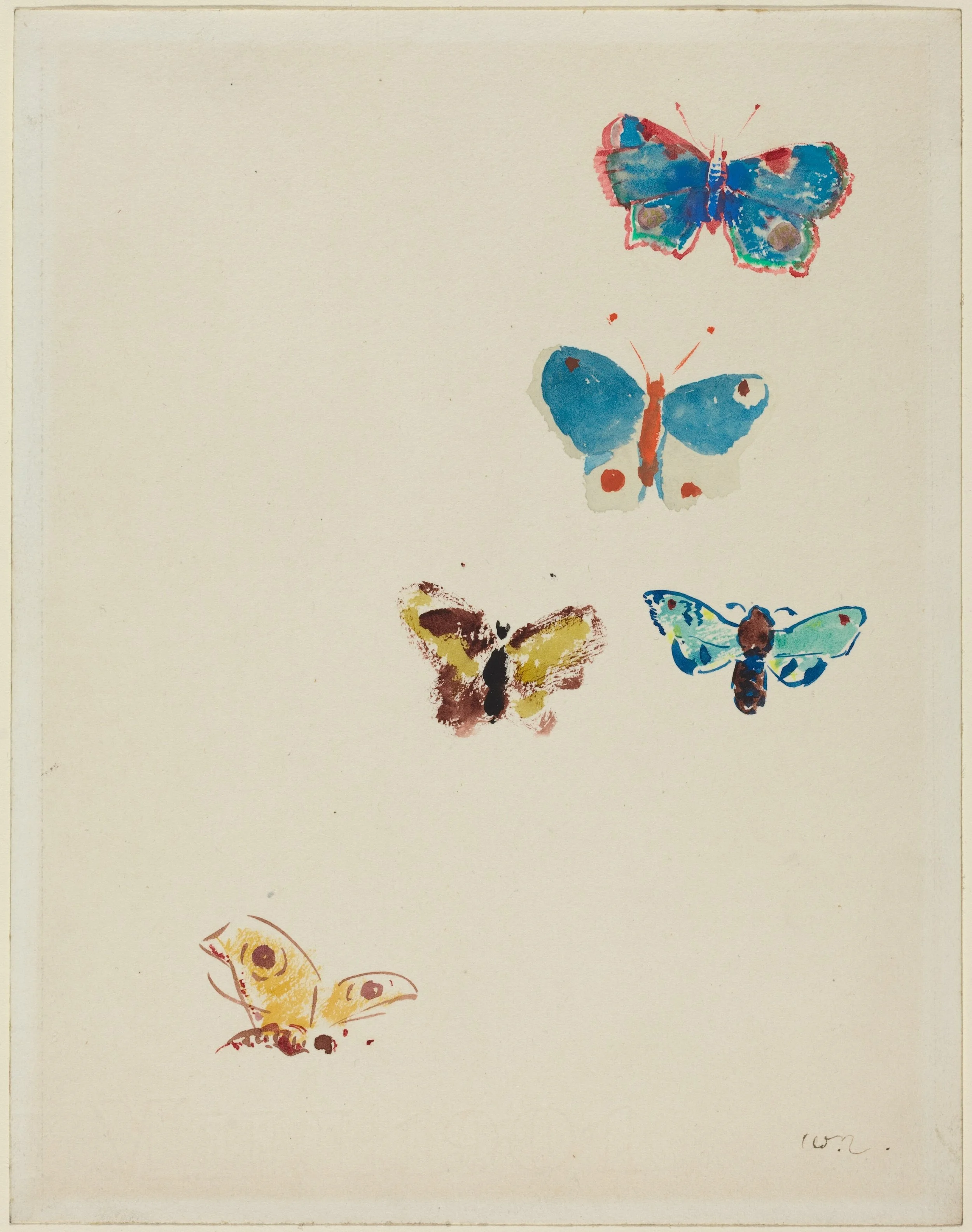
Five Butterflies by Odilon Redon, Courtesy National Gallery of Art, Washington
Basil liked simple thoughts. Bless his heart. He slept with his book against his chest. It was maybe eleven o’clock in the morning. He’d already dithered about his apartment for a few hours, and ate a bit, but, after he lay down on the couch to read, the heavy rain outside lulled him back to sleep. He didn’t dream of anything, and the rumble of thunder woke him back up. It was far off, and not particularly scary, but enough to remind him of the rain, and then that reminded him of the world.
He opened his eyes to find one of the moths at rest on the cover of his book. Its wings, like turquoise seaglass streaked with acid yellow, made the slightest motion. He always found their thickness to be odd. The plumpness of their bodies made no sense. It seemed off that such wings could fly. Gently, he lifted the book from his chest and held it level as he sat up and placed it on his coffee table. The moth stirred a bit, taking a few steps toward the spine, but didn’t attempt an escape. They were brave little creatures, to their detriment really; prone to landing in dangerous places. He’d adjusted to them–he stepped and sat more carefully–and didn’t mind them much, so he let them be. Both of them. The three mostly ignored each other, except for the niceties of cohabitation.
Basil stood from the couch and walked to the window. The other moth was at rest on the windowsill. In the light of the window it seemed inanimate. A toy of some sort. It wasn’t. It was very much a moth. But they often had that look to them.
The rain had reduced to a listless patter, even as the thunder continued to rumble in the distance. There was a gap in the clouds. Some sunlight made it through. The weather report on his phone seemed to think that another arm of the storm would pass overhead in an hour. Now seemed as good a time as any.
Basil made for the front door. He considered his maroon hat that hung on the rack, but took the hooded wax jacket instead. He slipped on his rain boots. He passed a neighbour in the staircase, who said what people say about rain to neighbours. Basil replied in kind. The air outside smelled nice. And it sounded pleasant against his hood. He liked the feeling of being so dry beneath the wax jacket. As said, he was someone who liked the simple.
Only a few cars passed him in the street, given that it was just before lunch on a Wednesday. A few figures passed on the opposite street. So he had only the flowers to look at. Purple and blue clusters of Hyacinths dotted the muddy grass beside the sidewalk, and Snowdrops hung their heads like pious nuns. When he came to a corner he saw that the park across the street had been thoroughly populated by these flowers, so he crossed toward it. It was a small park, with a few intersecting cement paths, a dozen or so large trees and a gazebo at one end.
At the point where each path met, in a larger brick circle at the park's centre, was a woman. She turned slowly, looking off into the grass and the trees, carefully. Right about when Basil reached the other side of the road, he saw her stop, and for a long time she gazed at a patch of Hyacinths. Then she walked toward them and crouched beside them, and put her fingers between their petals. The hem of her coat touched the soil. By the time Basil passed her she’d stood back up, but kept her gaze down at the flowers.
The cafe was a few blocks from there. A nice place. Always warm, and warmly lit, and decorated with an eclectic selection of chairs and sofas, so it felt like lounging in someone’s living room. A little dusty. Charmingly. And by the entrance there was the stage, with floor to ceiling windows. Here is where the performer sang. It was a young man, with a harmonica and guitar, sitting on a box drum. He played a few notes, and then pressed a pedal. The notes looped back around. He moved on to the next. He seemed to know what it meant to lose love, given the way he sang. Or, at least, he could create the effect.
It was busy that day, so Basil sat on a chair that never quite settled evenly on the floor, at a table with red flowers painted on it. The barista brought his coffee to him, along with the unground beans he’d come for. They spoke for a while. And at the end of a song, when the people at their laptops clapped, the barista went back to the till. Basil enjoyed his coffee.
It was about when he’d almost finished that he saw the woman from the park pause outside the door and knock the mud from her boots. When she came in she made for the till. She made small talk with the barista. And once she had her cup she turned to the man singing as well. And then, careful not to spill, she made her way between the tables. And, given that it was busy, she came toward him.
“Hi,” she said. “Could I?”
Basil nodded and gestured. And she sat. And for a little while it seemed the two of them would sit and listen to that sorrowful man. But when he finished his song, after pausing to appreciate a polite clap from the room, he got up and stepped off the stage. And it took a moment for the barista to play music into the silence left in his heart broken wake, so Basil said something.
“What were you looking for in the flowers?”
The woman wasn’t sure if he’d intended it for her, so she looked at him and seeing that he was looking back she figured he was and so she laughed. Her embarrassment was apparent.
“Sorry,” Basil added. “I saw you in the park on my way here.”
“Oh.”
“Did you lose something?”
“I- uhm. Yes.” She managed. “No luck though.”
“That’s too bad.”
She shrugged. “It was a while ago.”
“Alas, we lose things.”
“Alas.”
And for some reason that exchange of alas’ made them both smile.
“You live near here?” she asked.
“Just past the park.”
“Can I ask you a question about it?”
“The park?”
She nodded. “Have you seen butterflies there?”
“Butterflies?”
“Mhmm,” she nodded.
“Sure, it gets a few butterflies.”
She hummed. “Blue ones?”
“I couldn’t tell you.”
“Mmm,” She hummed again, this time disappointed. “I saw one in that park- last year, and I’ve been trying to track it down.”
Basil hummed as well and after a moment's pause he said that “butterfly tracks are hard to follow… given the wings.”
The woman across from him smiled, the sort of smile that refuses to be modest, and so forces the wearer to look away. She glanced at the empty stage.
“Yes,” she said. “It’s been a challenge.”
He smiled too. Music began in the speakers, less sorrowful than the man.
“Well… If you see a blue one… with maybe a bit of yellow on it…”
The description didn’t register in Basil for a moment. As said, he was a bit simple. In truth he still imagined butterflies.
“But yeah, thick, blue. If you see it… put up flare, or a flyer…”
“Thick?” He repeated, with emphasis, finally thinking laterally.
And she noticed the way he specified the word and recognized the tone of recognition in his voice.
“Could it be a moth?” he asked.
“A moth?”
“Yay big.” Basil approximated the size with his thumb and index. “Kinda weird looking? Beefy body?”
“That sounds about right,” she admitted, and then asked him where he knew them from.
“I have two,” He said. “Well… they live with me. They aren’t great roommates. I pay the rent and they eat my brown sugar.”
“What?” She smiled.
“I don’t know.” He smiled too. “They just appeared. And they don’t bother me, so I just let them be… they eat a grain of brown sugar… that’s about it.”
Basil, in his wonderful simplicity, didn’t know that moths don’t eat brown sugar… they don’t eat anything, actually, given their lack of mouth after they leave the chrysalis. He hadn’t thought twice about the sheer oddity of those two creatures. And, the woman he was speaking to didn’t know any Lepidopterology either, so she just nodded, as though what he was describing could, in any way, exist as such.
“What’s your name?” he asked.
“Lily,” she replied. “And you?”
“Basil.”
“Do you know what species they are?”
“The moths? No. I only know they’re moths because of the feathered antenna.”
“Moths…” she repeated. “You know. I’ve been looking into butterflies for almost a year. I’ve gone through so many catalogues. It never occurred to me to look at moths… I saw it during the daytime…”
Basil smiled and said there was a moral there somewhere. She didn’t follow, so he explained the joke. “You know, like staying open to new experiences… looking for butterfly tracks and missing the moth’s.”
She laughed, and gazed at him, her brow furling.
“The real adventure was the friends we made along the way… that sort of thing.”
The disconnect between the two proverbs made her smile too.
“Anyway,” Basil trailed off.
Silence approached. The silence that marks an end; the point in which the buoyancy of conversation finally comes to settle on the floor; when it might not set off again.
“Can I see them?”
“Sure,” he laughed. “You can have one.”
“And separate them?”
“They don’t seem to notice one another.”
“I’d like to see them, at least. But maybe I’ll take one off your hands.”
“I live just past the park.”
Despite the agreement, they lingered a while. By the time they left the rain had regained itself. Every block they walked they felt the drops enlarge and grow more frequent. It didn’t bother them. They had jackets. It was nice to be out. And so, when they came back to that park they forced their feet to slow. They passed the flowers.
“Why were you looking in the flowers?.”
“Well.” She laughed. “I figured I’d looked everywhere and hadn’t seen them… so I thought I’d look in the place where I might not have been able to see them… Does that make sense?”
“It does, in a strange way… though I suppose that means you have little to learn from my morals.”
“There’s always something to learn.”
He hummed his agreement, and looked at the flowers, and then the trees.
Lily spoke next, finally verbalising a train of thought that had been working its way through her.
“The one I saw was on some guy's hat, right over there, actually.” She pointed to a bench in the middle of the park, along the edge of the brick circle. “It had this weird… plasticky texture, so I thought it might be a decoration. But then it took off, and it flapped around a bit, and then… I lost it. I remember the texture being so strange, that’s what got me... A year of looking later and…”
Lily trailed off, but gestured to the park around them, indicating the passage of time up to the moment they found themselves in. And time brought them on to his apartment from there. They passed that same neighbour in the staircase, who asked about the rain. Basil replied that it’d been nice. As they opened his door the quiet anticipation of a new home settled over them. They didn’t have to wait long, for almost as soon as the door closed, one of the moths fluttered over and landed on his shoulder, as though coming to see who it was he’d brought home.
“Well…” Basil laughed. “Here’s one of them.”
She looked, and laughed as well, with the joy that comes at the end of so long a search.
“That’s exactly it… That’s them.”
“Here,” he said, carefully scooping the moth. “Open your hands.”
She did, and he placed his cupped hands into hers, and then pulled them apart. The little creature held onto his fingers for a moment, and then let go and passed from him to her. She gazed at it, her eyes wide.
“Is it what you expected?”
“No,” she replied. “It’s thicker.”
He smiled. “I’m always surprised they can fly.”
She smiled too, and looked up at him. Her eyes moved from his, to the coat rack behind him, where his maroon hat hung. She recognized it.
“How long have you had them?” She asked.
“About a year,” he replied.
She smiled. “They appeared on a rainy day?”
Basil nodded and placed a finger on her outstretched palm, so the moth could crawl onto it. “Out of nowhere.”
Kurtis Gregory is a fiction writer from Vancouver and is currently living in Montreal. He graduated from Langara College with a diploma in journalism, and is currently in his final year of the Concordia Creative Writing program. You can find more of his work in the second edition of Ahoy Magazine.