
Fiction by Laurie Legault
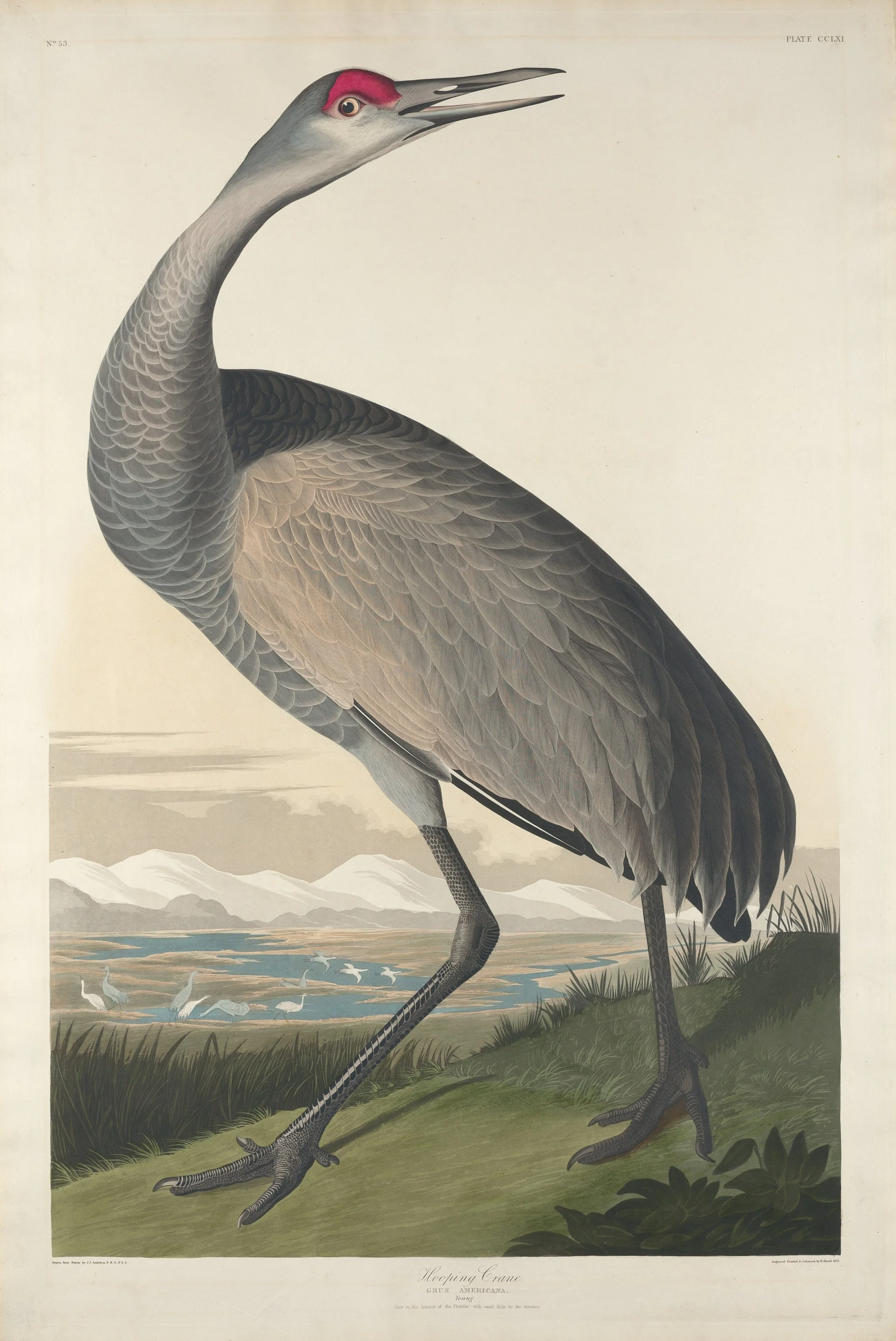
Hooping Crane by Robert Havell after John James Audubon, Courtesy National Gallery of Art, Washington
The sandhill cranes had still not shown themselves on the sixth, cold morning of October. The northern grasslands remained, without their presence, as they always had been: barren, still, and quiet. It stretched out in a haunting manner, an endless pale horizon merging blurringly with the sky. It was a land that knew no end and where barely any distinctions were made between its features. Even the clothes on the nearby clothesline—a simple rope tied to two posts—faded, in their monotonous colours of white, brown, and green, against their matching boreal background. Nothing save a river was snaking across the land to separate the mountain from the terrain. At this time of the year, frost was beginning to eat the morning tundra, the reddish and brown colours of the wheatgrass suffocated by the crystallized cold.
Marie sat watching the grasslands from the front porch, her back rounded as she leaned forward, wondering idly where the cranes could be and whether she had calculated this all wrong. Time was fleeting, and an urgency to migrate hung heavy upon the sedge as the cold settled in feverishly. The cranes had a habit of migrating in early October, and it was already late in their calendar. Yet, despite the weeks spent here already, watching day after day, waiting night after night, they never came.
Marie wrapped her wool cardigan tighter around her figure, eyes searching the empty terrain for a sign that she may have missed: she scanned the surface of every stone; every stretch of northern wheatgrass caressed by the wind; every ripple across the monotony of the water; and every inch of the white, lonely sky, begging for a sign of life to show itself in the shape of wings in this motionless, stiff landscape.
The shack groaned from behind her, and, in the open doorframe where the door clattered defyingly against the occasional gust of wind, came Mahikan. He held two mismatched, dented metal mugs from which a certain warm liquid fought against cold air. Eyebrows furrowed, he looked ahead with a tightened jaw and then down at Marie, who was still fixed in place on the wooden stairs. He sighed.
“Don’t you think it’s odd?” She asked him after a while, never once looking at him.
“What is?”
“The sedge is still absent. Winter is coming quickly this year. Where do you suppose they are?”
“I wouldn’t bother myself too much with that if I were you. Those damn birds do as they please.”
Marie took in his words but remained silent, and fixed the horizon as if the cranes would be magically summoned by their speaking about them. “Here,” he said, handing over a mug, which she took without protest and peered down to find it was coffee. However, she doesn’t take a sip; she only uses it to warm her hands.
“Ocicāhk are beastly creatures, with those large bodies, red heads, and sharp beaks. You are wasting your time.” He shrugs his chevron shawl properly back onto his shoulders and uninterestingly goes to sit on the balcony’s rusty rocking chair. From here, he lights himself a cigar. Apart from the whining wind, all present signs of life now came from the metallic creaking of the rocking chair, Mahikan’s low cough, and the groaning of the humble, wooden cottage.
Mahikan was a gaunt, dreadful old man with a slight limp and sunken cheeks. At least, that’s what Marie was told about him before she arrived a few weeks back. He was the only soul living this far out in the northern lands of Saskatchewan, thus why Marie had been referred to him to ask for the favour of staying with him. He surprisingly agreed, and, unaccustomed to welcoming guests in his home, had given it his best shot at repurposing a small work studio as her room. In the clumsy harmony of a place still learning to belong to two people, the cottage, through awkward pairings, quickly welcomed Marie as its own; a wooden chair dragged in from the porch faced Mahikan’s upholstered one at the table; a chipped ceramic cup pulled out from the kitchen cabinet so her toothbrush could stand next to his in a clay mug; her boots near the entrance, aligned under an unused landline phone secured to the wall. These scattered accoutrements multiplied over the days of Marie’s stay, and though they were not gaudy, they were enough to content her, and she gave the old man a few dollars in exchange for the stay. Now, with things being what they were, Marie’s schedule consequently adapted to the sedge’s absence.
Mahikan was Métis, born to a Cree mother and a white father, but that was all that she knew about the man. She quickly learned that Mahikan hated conversations, especially when they were about himself. It took a while before Marie could get around to him, and even then, he wasn’t always easy to come by: he was, despite himself, reserved, grouchy, and always pessimistic. Marie’s impression of him mainly consisted of observations she occasionally stole out of his obliviousness. It happened, as he was splitting wood on the front lawn one day, that Marie caught him through the window. She watched as Mahikan raised the axe, and his flannel slipped under the weight of gravity, revealing his skin tainted red with passionate scars. Their friendship formed over the silent, mutual understanding that no questions would be asked, and they bonded over each other’s company in these lonely lands.
After finishing his cigar, Mahikan stood slowly. Marie followed the sounds of his heavy footsteps carrying him from across the porch back to the threshold. “You'd best come in before the cold catches you.” His voice was hoarse.
“What if they come while I’m not here?” She asked, still consumed by all unanswered questions. She heard him sigh.
“At least drink the damn coffee if you’ll be as stubborn as to stay out here all day.” He muttered as he closed the door behind him. She remained fixed in place only a few minutes longer until her coffee succumbed entirely to the freezing air.
Inside, it was warmer. Mahikan had just started a fire from the old furnace, which imbued the single-floor cottage with the smell of burning wood. The man was found sitting at the wooden table, mindlessly carving a wolf effigy out of aspen; somehow, he always needed to keep his hands busy. Around him, scattered on the table, was the week’s unfinished work of stitching a shawl, repairing leather, and doing some beadwork. Although Mahikan had never explicitly said so, Marie understood by watching him work that he preferred the gentle patience of thread and hide to the harsh work of axe and fire.
She silently went to empty the coffee down the sink and sat across from him, watching his old hands work diligently; his eyes narrowed in focus and were caught up in the quietude of making, as if by instinct for when the mind grows loud. From where she sat, she could see her bedroom door ajar just enough to reveal her painting easel facing the window, and next to it, the abandoned mess of paintbrushes cluttered in a glass cup—tainted in colours she hardly had the chance to use. Only an idealized outline of a crane, stemming from the very few strokes she had felt confident enough to produce, took form on the canvas.
“What if they never come?” Marie asked, half to herself.
“Then you’d best move on.” Mahikan’s voice was bored, and his eyes remained fixed on his work.
“That can’t be possible, can it? They can’t stay here all winter; they’ll have to migrate.”
“And they’ll do that just fine without you sitting hours in the cold waiting for naught.” He gestured towards the chisel, which she handed him.
“How would you know it’s for naught? I’ve studied these birds for years, and I've never heard of a bird that never migrates. It’s bound to happen.” Her gaze instinctively flickered to the window above Mahikan’s shoulder.
“You have your answer then. Mind helping me with the moccasins?” She does. Mahikan had taught her—in the absence of her painting—how to stitch and bead, and Marie accepted gladly, in need of feeling useful. Lately, Mahikan had been in the process of mending worn moccasins, mittens, and leggings, all before winter could settle in. As their hands worked mindlessly, Marie’s head was still spinning, despite herself, with thoughts of the cranes. They haunted her dreams, constantly imagining the paintbrush capturing those final, defining strokes at last.
“Winter’s catching up fast. I don’t think it’ll be kind this year.” Mahikan said seriously. He was still completely consumed by the effigy, carving out the wolf's muzzle.
“Have you enough wood?”
“Nearly. But not enough for two.” Marie’s jaw tightened. Just how long was she going to stay here? How long was Mahikan expecting her to stay?
“Should the cranes show, I’ll be on my way home soon.” She reminded him. She peeked at him from under her eyebrows, but Mahikan didn’t seem fazed. He remained in quiet contemplation of his woodwork progress and seemingly pretended not to have heard her, as if that would make her statement any less true. She tried to change the subject.
“I’ve heard that in your tribe, sandhill cranes signify faithfulness.”
“That’s the word, anyway,” he said, “though I’ve always thought it was a funny thing to say about a creature that spends half its life leaving.” He set the finished wolf amulet aside and reached out for the shawl that needed stitching, where a loose thread had come undone and caused damage.
“I think they would know love. Sandhill cranes mate for life after all.”
“So they say.” Mahikan’s indifference ruffled her feathers. He rolled his sleeves up to his elbows, and Marie accidentally noticed from under her eyebrows the scars on both his arms. They were cruel in shape and ran across his dark skin like red rivers. She lowered her gaze back onto the moccasins, pretending she hadn’t seen and hoping Mahikan hadn’t noticed. The wind howled against the cabin, and Marie thought, for a second, that it might’ve been the sound of wings.
“I’ve always thought that to be a beautiful thing.”
A scoff. “What if they forget who they chose?” Uttered with such instinctive sureness, Mahikan’s question took Marie by surprise. She looked up at him and felt speechless, then. An uneasy consciousness gradually began dawning upon Marie. Her eyes stole a glance toward the window over his shoulder, realizing sunset was sure to come soon. Stirred, she quietly tried to return to her work and passed a beaded thread through the vamp of the moccasin to secure it.
“The bathroom sink is going to need some fixing.” She reminded him.
“It’s leaking again?”
“I noticed it just this morning.”
“Unreliable, rusty, old sink.” Unbothered, her friend continued stitching the shawl, making a mental note for later.
Mahikan eventually glanced at the fire and sighed, yielding the shawl forward as if unable to pursue undisturbed. He was looking at Marie now, perhaps for the first time since the start of their exchange, and, knowing she could not tame the yearning inside her, said:
“You forget yourself. You could study them for years and still not understand why they do the things they do. At the end of the day, they are wild animals. And that makes them unpredictable.” He rose from the table before she could protest and threw some logs on the dying fire. Smoke coiled up the chimney. Once Mahikan returned, he proceeded with the stitching; the damage from a single loose thread had spread far too quickly, and he was having a hard time securing the casualties without other areas breaking loose.
Silence ensued, both dazed and sullen, where none dared to continue the conversation. Having finished the moccasins, Marie set them on the table’s surface and pushed them out of the way. Wordlessly, she lifted the edges of the shawl and slowly helped her friend piece it back together.
“We don’t have enough wood for two. At this rate, we barely have enough for one.” Mahikan said.
“Then we’d best keep the fire alive while we can.”
“I’ll have to split more in the morning if we want to tough the winter.”
Silence. She heard Mahikan sigh again. “What if the cranes don’t show before winter? If you can’t paint them, what will you do then?”
“A part of me wishes to wait until they do.”
“You’ll be waiting till the snow’s knee-deep,” he muttered.
“If that’s what it takes.”
“You’ll catch your death waiting for them.” His voice was raspy and raw. “You’re being foolish, girl. You’ll learn that the wild don’t wait for us.”
“I am not foolish.”
“Yet here you are, miles away from home chasing these silly beasts. Why?”
Her grip tightened on the shawl. “Perhaps you are right…” She pursued with a sadness in her voice, scarcely audible. “But, should that really prevent me from trying to see them before they leave? If only to paint one more line…” Mahikan didn’t answer right away. “Because, truly, if you had the chance, would you have waited too?” She asked. His needle stopped mid-sew. “I’ve waited enough.”
Marie remained silent. She looked outside again and then at her painting easel. The sun was beginning to wash away, an orange haze fading into black. The horizon was pale and endless. The cranes were still absent, and nothing could indicate whether they’d ever show; with an instinctive hopefulness, she thought—perhaps tomorrow.
Laurie Legault: I am a second year Creative Writing (BA) student at Concordia University, Montréal. Originating from Québec City, I am a young and passionate short fiction writer dedicated to capturing raw, human emotion within my work, such as anger, grief, nostalgia, denial, and love. I enjoy writing about life as it once was; what it means to be imperfect humans; our search to be understood and our need to find connection in a world that feels otherwise big, lonely, and indifferent.